Dogliani! This quiet and beautiful town in Piedmont, slightly out of step with its time, yet still very much of the present! Such places still exist: places where dining is not conceived as an event, but as a natural continuation of life.
For me, one of these special places is the Pizzeria «La Lanterna». When we arrived in Dogliani on a Friday evening in late November 2024, there was already something special in the air for me, because of the everydayness of it all. The drive from Switzerland had stretched into the late evening, that peculiar window of time between exertion and arrival, when the body is tired but the mind is already anticipating what might still be possible that evening and over the following days. We had arrived at this beautiful apartment in the old town, but we were still hungry. And it seemed out of the question that we would find anything to eat at 11 p.m.
Still, the door of «La Lanterna» was open. We stepped inside cautiously, almost apologetically, asking for “just something small.” One of the sons of the family—a figure of peculiar erudition, almost professorial—listened to us, looked at us calmly, without hurry, and briefly disappeared into the kitchen. There, as we learned much later, his brother Dario works. He came back: «Si puo.»
What followed was less a simple meal than a kind of—I’ll put it somewhat exaggeratedly—initiation into Piedmontese cuisine. «Tagliolini con Funghi Porcini»—a dish whose simplicity leaves hardly any room for error, and in that very simplicity reveals everything. Perhaps it was the hunger, perhaps the long drive, perhaps the knowledge that the night and the beauty of the apartment awaited us—but this dish, in all its simplicity, was something special, something that cannot be repeated because it was born of that particular moment. An arrival in Piedmont in the truest sense.
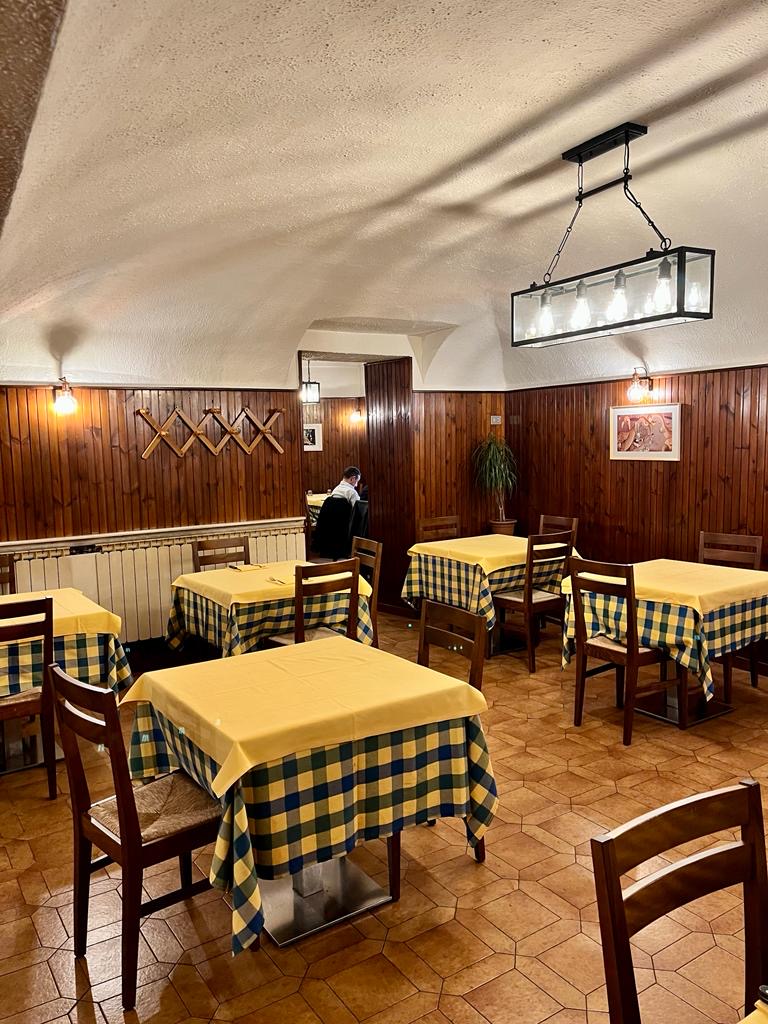
The few guests who were still there sat at plain tables on simple chairs, finishing their desserts at best, drinking their grappa. Nothing was staged. Later, friends told us that the restaurant had been renovated a year earlier, and that some people still mourned its former charm—the same for forty years. For us newcomers, however, its simple beauty still worked its magic: here, good food is cherished, not for its own sake, but in service of convivial life. It is as far removed from tourist spectacle as anything we have experienced in a long time; it was simply a real experience.
Later, we kept coming back. The Pizza al Tegamino—excellent, a Turin specialty, marked by a quiet care that needs no explanation. One Saturday evening I sat there alone; the restaurant was packed—«of course, we have a table for you»—surrounded by others, and yet I felt completely unobserved, simply enjoying the moment quietly among them. That, too, is a quality: a place that welcomes you without taking you over.
And again and again, the son—we now know his name is Marco—who not only explains the dishes skillfully, but also, when the occasion arises, discusses the particularities of the Italian language with great enthusiasm: When do you say «tavola», when «tavolo», and why? These seemingly incidental digressions show that here, culture and everyday life are not separate, but come together as a way of life. Eating, speaking, and thinking share a common source.
The menu follows no fashionable dramaturgy. It is shaped by what the region has to offer: pasta such as tagliolini or tajarin, seasonal mushrooms, simple antipasti, hearty meat dishes, and a pizza that makes no attempt to pass itself off as exotic. To finish, a «dolce»—homemade—then a grappa. No excess—well, all right, one more glass—a quiet rounding-off of the evening.
Oh yes, there was also that dessert: it is made by the mother, Rosita, herself. Marco says that this «dolce» really doesn’t look «beautiful» at all, but that it is a specialty and has the potential to become «veramente» a Piedmontese memory. It is called «Bonet», somewhere between pudding and flan—made with eggs, milk, sugar, and cocoa, with a thin layer of caramel on top.
Finally, when the evening had long since settled in, he came over to us once more—not intrusively, but with a casual purpose: tomorrow, he said, they would have «Coniglio di Cuneo alla Cacciatora», rabbit prepared hunter-style. And he explained, as if giving a little lecture, what makes Piedmontese cuisine special. Anyone who wants to eat classic Piedmontese cuisine is in good hands here.
«La Lanterna» is not a place for spectacle—and that is precisely what makes it special. It always fits. And sometimes, as on that first evening, it becomes the setting for a quiet, almost romantic Verdi thing: two people arriving and eating—without many words, simply in the moment. One could, of course, read reviews, count «Google» stars, compare comments.
But that seems almost absurd. These places elude the framework of fleeting or resentful reviews because they do not aim to make an impression. «La Lanterna» is simply there, and asks you to form your own opinion. Perhaps that is a practice that has become rare today: trusting your own taste, cultivating it, and taking it seriously as part of a way of life.
A note from Serafina Kulturverein
This article brings together the perspectives of two people closely connected to our project: Nicolaj van der Meulen, the author of the text, was an Artist in Residence at our house in Dogliani Castello in 2024. Photographer Ulla Schneeweis also visited us with her husband Fabian in April 2022 as part of our Artists-in-Residence program. The two are the creative minds behind our analog print workshop.
Ulla’s photos show La Lanterna in 2022, still in its original state. We deliberately chose this series for the article: it captures the atmosphere that many regulars still look back on with great affection. Ulla herself also experienced the “old” La Lanterna—the images are a personal snapshot and, at the same time, a piece of memory of a restaurant that for more than four decades was a familiar meeting place for many people.